

Themes

Themes
Folk songs have many common themes that have resonated with people throughout different periods of history. Below is an introduction to some of the popular themes found in English folk songs. These categories are listed for convenience and some songs might fall into more than one section.
Cross-Dressing and the Performance of Gender
There are many folk songs that tell stories of cross-dressing, often with women dressing as men. Sometimes this is in order to follow a man they love and sometimes they are pursuing an occupation that was not open to women at the time (such as working the military or on board a ship). This also gave these women an autonomy and freedom that women wouldn’t otherwise be able to access in the past.
Some examples of songs about cross-dressing:
- The Female Drummer - Roud no. 226.
- Sovay - Roud no. 7.
- The Female Rambling Sailor - Roud no. 17784.

A printing of The Female Rambling Sailor. Image: VWML digital archive.
Customs
There are many folk songs about customs and traditional celebrations that happen at certain times of year. Often these will be specific to a certain area and their particular traditions.
Types of traditional dance and drama, including processions, morris, longsword and mummer’s plays, also have songs related to them.
Some examples of songs about customs:
- Pace-Egging Song - Roud no. 614.
- Earsdon Sword Dance Song - Roud no. 610.
- Padstow May Song - Roud no. 305.

Performers and spectators at the Padstow May Day celebrations in 2007. Photo: Brian Ledgard.
Comedy
Comedic folk songs can contain wordplay, jokes told over several verses, or sometimes even be parodies of other well-known or serious songs. Some have origins in the music hall and were so popular that they entered oral singing traditions. Songs that might have improvised verses (such as sea shanties), also lend themselves to comedic content.
Some examples of comedic songs (content warning: some of these song contain bawdy lyrics):
- Butter and Cheese - Roud no. 510.
- Our Goodman - Roud no. 114.
- Cock-a-doodle-do - Roud no. 3464.
Drinking Songs
People often sing together at special occasions and social gatherings, and as people often drink at these events, there are many folk songs about drinking and having a good time. A lot of these songs celebrate the company in which the singer finds themselves and they often have a chorus that people can join in with.
You can also find songs about the process of making alcohol.
Some songs related to drinking:
- Ye Mariners All - Roud no. 1191.
- Who’s the Fool Now? - Roud no. 473.
- John Barleycorn - Roud no. 164.
- Hopping Down in Kent - Roud no. 1715.
Historic Events and Figures
Some folk songs tell stories of famous events, real people and other things that were considered newsworthy and worth commemorating. Often they have changed over time and may not be historically accurate, but they are a great window into societal attitudes to events at different points in time.
Some examples of songs about historic figures and events:
- Peterloo - Roud no. V17535.
- Nelson’s Monument - Roud no. 1552.
- The Death of Queen Jane - Roud no. 77
Heroes and Villains
There are many folk songs that tell stories of heroes and villains. These may be folkloric or mythical figures, or true stories of real people, that might have become distorted over time. You can find songs about characters such as Robin Hood, famous pirates and highwaymen, amongst others.
There is also a subsection of songs known as ‘Goodnight Ballads’ - first person accounts of criminals admitting their sins (usually with no regrets) before being condemned to die. Many of these were written by broadside ballad sellers capitalising on popular news stories.
Some examples of songs about heroes and villains:
- Turpin Hero - Roud no. 621.
- Robin Hood Rescuing Three Squires - Roud no. 71.
- Sam Hall - Roud no. 369.
Factories and Industry
With the rise of the industrial revolution, industry was the daily occupation of many people. This means there are songs about the hardships of day to day work in factories and industrial jobs, and also love songs associated with those trades.
Fishing and whaling songs also reflect historical trades that were carried out on a large scale as part of an industrial process.
Some examples of industrial songs:
- The Factory Girl - Roud no. 1659.
- The Poor Cotton Weaver - Roud no. 937.
- The Yarmouth Fishermen’s Song - Roud no. 2434.
Folklore and Magic
Many folk songs contain narratives that include folkloric and magical elements. These can include:
- Ghosts.
- Magical or mythical creatures (often talking creatures).
- Shape-shifting.
- Spells and witches.
- Fairies and elfin people.
- Superstitions.
- Rituals and offerings.
These most commonly occur in ballads (especially in the ‘Child Ballads’ categorised by F. J. Child).
Sometimes these magical and folkloric elements are very old, appearing in songs recorded hundreds of years ago, and sometimes these elements have been added later in the song’s life and are not in all the known versions.
Some examples of songs with folkloric and magical elements:
- The Broomfield Hill - Roud no. 34 (Child Ballad 43).
- The Two Magicians - Roud no. 1350 (Child Ballad 44).
- The Unquiet Grave - Roud no. 51 (Child Ballad 78).
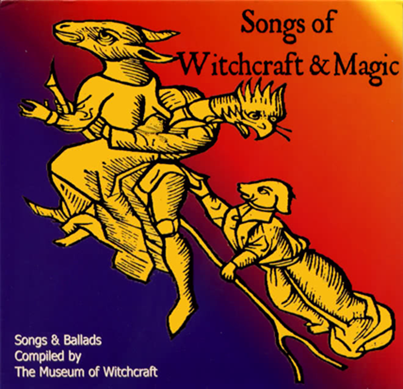
A compilation album made by The Museum of Witchcraft and WildGoose Records featuring versions of traditional songs about witchcraft and magic. Image: Museum of Witchcraft and WildGoose Records, 2007.
Gypsy and Traveller Songs
There are many folk songs in the traditions of Travellers and Gypsies in England, as well as songs that contain narratives about them.
In England, the main ethnic groups that feature under the umbrella term Gypsy and Traveller are Romani Gypsy people, Irish and Scottish Travellers, as well Roma who have arrived in more recent decades (although the histories and terminologies are not straightforward and many groups and individuals prefer different ones).
Gypsies and Travellers in England have a rich history of music, dance and song. These oral traditions continue today and some Travellers and Gypsies have become performers on the folk scene.
Songs from Romani Gypsies and Scottish and Irish Travellers are often connected to traditional folk songs sung by other communities in England. First revival song collectors were very impressed by the singing of Irish and Scottish Travellers and Romani Gypsies, and gathered many songs from them. However, the ethnicity of singers was usually not recorded, so their contributions have often been marginalised and overlooked.
There are also many folk songs with narratives depicting Travellers and Gypsies. Often they are portrayed in a stereotyped, and sometimes appropriated, way, where their lives are romanticised to rambling down winding country roads and camping beneath the stars. In these songs, the travelling way of life often becomes a motif of escapism and a way for a non-travelling person to break free from the constraints and conventions of English society. This is in stark contrast to the racism Gypsies and Travellers have experienced historically, as well as in the present day. As a result, care has to be taken when thinking about singing these songs and what is appropriate.
Some examples of Gypsy and Traveller songs:
- What Will We Do When We’ll Have No Money - Roud no. 16879.
- The Squire and the Gypsy - Roud no. 229.
- I’d be a Gypsy - Roud no. 17498.
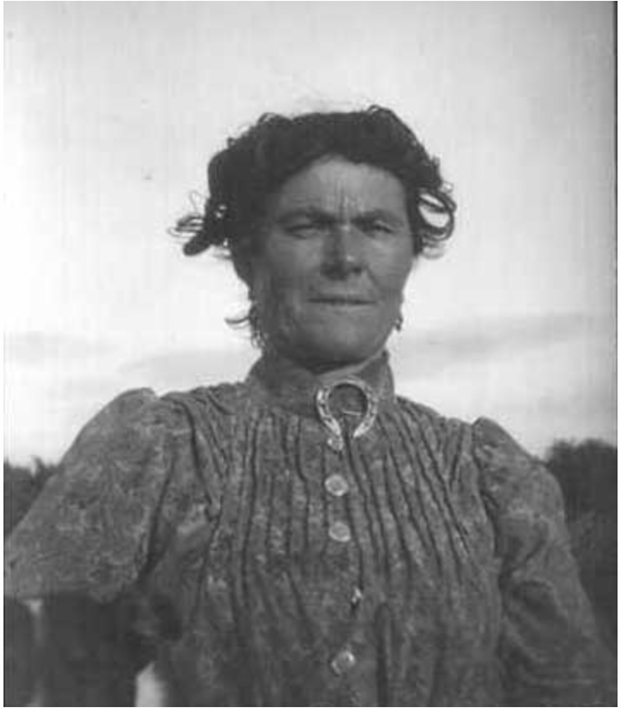
Priscilla Cooper (1865 - unknown), who was listed in the 1901 census as a ‘travelling Gypsy’ and was probably one of the first Gypsy singers to be recorded in the UK when Cecil Sharp visited her in Devon in 1907/8. Photo: Cecil Sharp.
Love
Just like in pop songs, ‘love’ is probably the most common subject in folk songs. These songs range from happy ones to tragically sad tales. Sometimes love is just a strand of the narrative and part of a wider story, and in other cases it is the whole point of the song.
There are also a subset of folk songs about romantic love, which use floral, herbal and tree symbolism to tell stories. Common symbols are:
- Rose - love, sensuality, passion.
- Willow - sadness, grief, particularly a feminine sadness.
- Violet - modesty, faithfulness, everlasting love.
- Rue - regret, sadness.
- Thyme - courage, bravery - sometimes having a double meaning with ‘time’.
- Lily - innocence, purity, virginity.
As well as songs about romantic love, there are also English folk songs about other kinds of love such as familial love or love for your country.
Some examples of songs about love:
- The Turtle Dove - Roud no. 455.
- The Tan Yard Side - Roud no. 1021.
- The Seeds of Love - Roud no. 3.
- The Wife of Usher’s Well - Roud no. 196 (Child ballad 79).
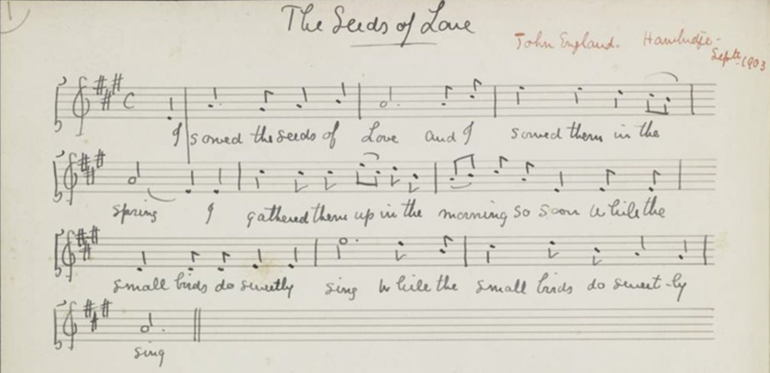
Cecil Sharp’s notation of John England’s singing The Seeds of Love in Somerset in 1903. This is the first folk song Sharp collected and is sometimes seen as the start of the first revival song collecting movement. Image: VWML digital archive.
Mining Songs
The history of mining in England goes back to Roman times and it has been an important industry at many points in history. There are far fewer working mines still open today, and some mining and former areas still strongly associated with the industry, such as the north east, the midlands and Cornwall. As a result of this, there are many folk songs about mining and colliers.
Many folk songs about mining were repopularised and politicised by the pit closures and miners’ strikes that took place in the latter half of the 20th century, and the devastation this caused to mining communities, the resonance of which is often still felt by people in those areas today.
Some examples of songs about mining:
- Black Leg Miner - Roud no. 3193.
- Byker Hill - Roud no. 3488.
- The Old Miner - Roud no. 1136.

Miners in front of a mine in 1912 during a strike. Image: public domain.
Night Visiting Songs
Night visiting songs tell the story of a secret meeting of lovers at night, often with a man travelling to a woman’s house and knocking at the window. The stories usually end with the travelling lover having to leave early in the morning, and quite often going against their promise to marry.
There are many of these narratives in traditional folk songs, and even some recently written songs, and they can vary from being lighthearted, to sad or even ghostly.
Some examples of night visiting songs:
- Cold Haily Windy Night - Roud no. 135.
- Jack the Jolly Tar - Roud no. 511.
- The Lover’s Ghost - Roud no. 179 (Child Ballad 179).
Poaching and Hunting
There are many folk songs about poaching (the illegal capturing and killing of animals on land that you don’t own or have permission to hunt on), and hunting (the legal capturing and killing of animals on land you do own or have permission to hunt on). These songs are often about the pursuit of animals such as hares, foxes, deer and whales. These include:
- chorus songs intended for communal singing at the end of a day’s hunting.
- songs that sympathise with the hunted animal or are from the animal’s point of view.
- songs of successful poaching.
- songs about being caught for poaching and the consequences
There is a strong class element to these songs as one of the main differences between hunting and poaching is your place in society and whether you were from a landowning class.
Some examples of songs about hunting and poaching:
- Dido, Bendigo - Roud no. 584.
- In Thorneymoor Woods - Roud no. 222.
- On Yonder Hill There Sits a Hare - Roud no. 5173.
- Geordie - Roud no. 90 (Child Ballad 209)
Politics and Protest
Protest songs have a long history in the world and are sometimes categorised as a separate genre, but they are also very much part of English folk singing traditions.
England has a rich history of protest and this is reflected in English folk songs. You can find songs about specific marches and protests, songs that directly protest about something or have a political message, and also songs that are sung at protests.
There are many historical English folk songs of protest, including ones that oppose political injustice, personal injustice, class based oppression, or voice anti-war sentiments.
There are also many modern and contemporary English protest and anti-war songs. These can be seen as growing out of the protest song movement in 1950s USA, which aligned with issues such as civil rights, the women’s movement and anti-war movements.
The very nature of folk song is also inherently democratic, as a particular song would only be sung and remembered if people liked it and kept singing it. English folk songs are also rarely associated with the ruling classes and so more closely reflect the general public’s values and opinions. Broadside ballad sellers would pick up on these values and create lyrics aligned with them, as songs that reflected the public’s opinions would sell better.
Some anti-war and protest songs:
- The Factory Operatives Call on Humanity - Roud no. V16539.
- Diggers’ Song - Gerrard Winstanley - Roud no. 1521.
- I Wish the Wars Were All Over - Roud 2036.
- The Crow on the Cradle - Sydney Carter.
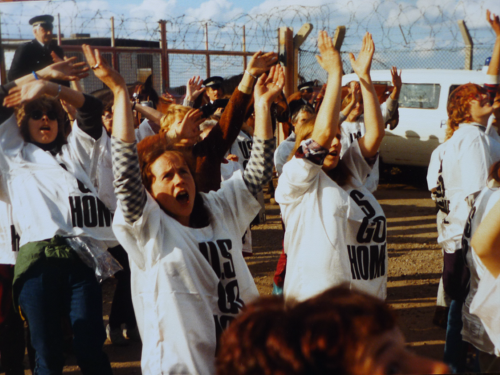
Women at the Greenham Common Women’s Peace Camp in the 1980s, singing in protest against plans to store US nuclear weapons there. Photo: Bridget Boudewijn, from Greenham Women Everywhere.
Religion
Some folk songs contain religious, usually Christian, narratives or references. You can find many that are related to festivals such as Christmas and Easter, some that began as church hymns and subsequently entered oral folk singing traditions.
There are also many ‘apocryphal songs’ - songs that contain religious stories or texts that are not part of an accepted canon of scripture.
Some examples of songs with religious themes:
- The Bitter Withy - Roud no. 452.
- The Good Old Way - Roud no. 23864.
- The Cherry Tree Carol - Roud no. 453.
- The Seven Joys of Mary - Roud no. 278.
Rural Life
There are many folk songs about rural and farming life, or that are set in the countryside. This is partly because song collectors often focused on rural areas, due to their biases about what a folk song was, as well as longstanding associations of ‘folk’ with rural people and an idealised pastoral lifestyle.
Historically there have been many people living in the countryside, and it was only from 1851 that Britain became the first place in the world with more people living in towns and cities than in rural areas. This potentially contributed to a feeling of nostalgia towards rural life, as well as the element of escapism it can offer, sentiments which can still be seen in today’s world.
You can find songs about traditional rural activities such as hay-making, sheep-shearing and harvesting, as well as many songs with a rural setting. Some of these songs are the reflections of people who lived and worked in the countryside and some are romantic exaggerations, written by urban songwriters with a rose tinted view of country life.
Some examples of songs about rural life:
- The Jolly Thresher - Roud no. 19.
- Rosebud in June - Roud no. 812.
- The Merry Haymakers - Roud no. 153.
Sailors and Soldiers
Aside from sea shanties sung on board ships (see above), there are many other folk songs about sailors, as well as soldiers. These range from stories of:
- heroic deeds.
- romantic liaisons - both couples parted through service, or the casual liaisons of visiting sailors and soldiers.
- press gangs forcibly conscripting people into the military.
- desertion and the consequences.
- women cross-dressing in order to become a sailor or soldier.
- historical tales of battle (with varying degrees of accuracy).
Some songs also celebrate people who may not have been decorated by history, showing how the songs people sang and passed on were not (and are still not) controlled by an establishment, but instead reflect the opinions and values of real people. A common example of this is songs which are sympathetic to (or even pro) Napoleon, as it’s believed some people thought he would come and rescue them from their poverty in England.
Some songs about sailors and soldiers:
- Polly on the Shore - Roud no. 811.
- The Deserter - Roud no. 493.
- Our Captain Cried - Roud no. 602.
- The Blue Cockade - Roud no. 191.
- The Young Sailor Cut Down in His Prime - Roud no. 2.
- The Grand Conversation on Napoleon - Roud no. 1189.