

Types of Folk Song

Types of Folk Song
Below are some different types of English folk song you can find. The categories and definitions given are a beginners’ guide and are not authoritative or definitive statements. Many songs also will fit into multiple categories, even if they are listed as an example of one.
Ballads
Ballads are a type of narrative folk song. They often have lots of verses and a structurally simple tune. Their stanzas are often four lines long, sometimes with repeated refrain lines in the verse. They often recount folk stories or historic events (with varying degrees of historical accuracy).
Ballads are a storytelling form found across Europe and in North America, and they have strong links to other European storytelling traditions.
During the 18th and 19th centuries there was a wave of interest in ballads that saw traditional songs and stories influencing literary writers, and many poets experimented with this form of storytelling
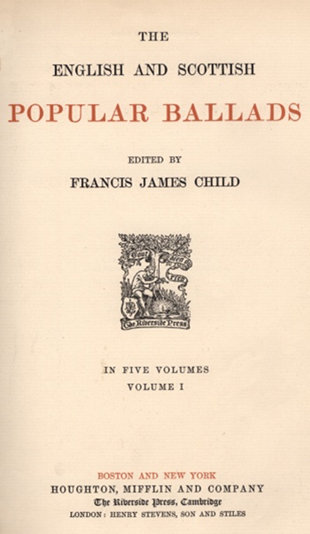
The 1904 Houghton Mifflin edition of Child's English and Scottish Popular Ballads. Image: public domain.
In the late 19th century, the texts of many ballads and their variants were famously compiled by scholar Francis J. Child in a publication called ‘The English and Scottish Popular Ballads’. 305 ballads were included and numbered and those songs are often referred to as the ‘Child Ballads’.
In the 1960s, Bertrand H. Bronson compiled the melodies of many ballads using Child’s numbering system in his book ‘The Traditional Tunes of the Child Ballads’. These ballads are included in the Roud Index and both systems of numbering are still referred to today.
Many ballads, and oral singing traditions in general, survived much longer in Scotland and very rural areas, perhaps due to industrialisation and modern methods of entertainment also reaching these places much later. This means that more ballads were collected from these places around the turn of the 20th century, but evidence of transmission shows that ballads were more widely sung in the past.
The term ‘ballad’ is also used in the modern music industry to refer to slow, romantic pop songs, but these are not connected to folk ballads.
Some examples of ballads:
- The Bold Pedlar and Robin Hood - Roud no. 333 (Child Ballad 132).
- The Two Sisters - Roud no. 8 (Child Ballad 10).
- Lord Bateman — Roud no. 40 (Child Ballad 53).
Broadside Ballads
Also known as ‘broadsheet ballads’, these were in many ways the forerunner of the modern newspaper (the term ‘broadsheet newspaper’ is still used today). They were printed on large sheets of cheap paper and typical content included a ballad, a rhyme, news and sometimes woodcut illustrations.
Between the 16th and 19th centuries broadsides were one of the most common forms of printed material, and were mass-produced to tie into any occasion - journalistically recounting the ‘facts’ of a battle, a murder, a wondrous event, or sometimes just reprinting a version of a popular traditional song or ballad.
Songs words would usually be printed without a written melody, and sometimes with a reference to a well-known tune that they could be sung to. They would be sold on the streets by ballad sellers, who would often sing.
Some examples of broadside ballads:
- Maria Marten - Roud no. 215.
- The Woody Queristers - Roud no. 747.
- Cupid’s Garden - Roud no. 297.
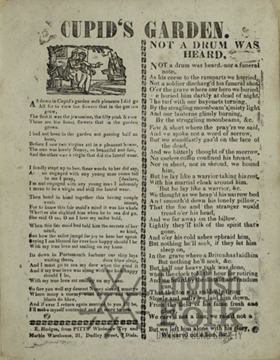
A printed broadside that includes the song Cupid’s Garden. Image: from the Vaughan Williams Memorial Library digital archive.
Border Ballads
There are a great number of traditional ballads from the borders between England and Scotland (Lowland Scotland and Northumberland), which are often referred to as 'Border Ballads’.
At points in the 15th and 16th centuries, this area was known for its’ ‘lawlessness’ and referred to as the ‘Debatable Lands’, ‘Middle Shires’ or ‘Scottish Marches’. Clans and families would switch allegiance between the English and Scottish monarchy frequently and groups of ‘reivers’ would raid and feud as a way to gather wealth and goods.
Border Ballads are often heroic songs celebrating feuds, raids and even elopements on the border.
The popularity of all things Scottish in the Romanticism movement of the late 18th and early 19th centuries helped to develop an interest in these songs and inspired later collectors of traditional folk songs.
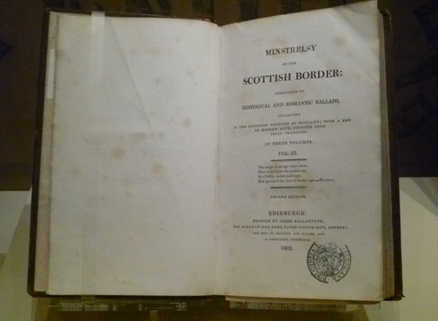
A copy of ‘Minstrelsy of the Scottish Border’ by novelist, poet and historian Walter Scott (1771 - 1832), in the National Museum of Scotland. Photo: Kim Trayner, licensed under CC BY-SA 3.0.
Carols
Carols can loosely be described as songs of celebration, usually associated with a particular festivity and sometimes religious in nature. The term derives from the Old French ‘carole’, which originally referred to a circle dance accompanied by singing.
Today, carols are most strongly associated with Christmas, and there are plenty of these carols in the English folk tradition. Many commonly well-known Christmas carols also have roots in traditional songs and tunes.
There is also a tradition of ‘pub carols’ (sometimes known as ‘folk carols’ or ‘Sheffield carols’) which happen in pubs in the Sheffield/Derbyshire area, and more recently in other parts of the country too. This tradition would have happened all over the country around 200 years ago, when carols were not considered appropriate to sing in church and different villages had their own versions of songs. These carols are generally sung without any religious context and not as part of worship.
There are also many carols in the English folk tradition that celebrate other occasions and festivities, such as May and Easter. There are actually more English folk songs about May than about any other time of the year, except Christmas.
Some example of carols:
- Bedfordshire May Carol - Roud no. 305.
- Seven Joys of Mary. - Roud no. 278.
- The Leaves of Life - Roud no. 127.
- May Song - Roud no. 702.
Chorus Songs
There are many English folk songs which have a repeated chorus or refrain between the verses. These often were, and still are, an important part of social gatherings, where everyone can join in with the singer on a chorus or repeated refrain.
Sometimes the popularity of a song’s chorus is what has kept so many people singing it over time, with the verses being less well-known. A chorus can also help keep listeners engaged in a song, giving a break before the content of the next verse.
Some examples of chorus songs:
- A Farmer’s Boy - Roud no. 408.
- Let Union Be - Roud no. 1238.
- If I Were a Blackbird - Roud no. 387.
Cumulative Songs
Cumulative Songs are a particular kind of chorus song where an extra line is added to a repeated refrain every time there’s a new verse. These songs develop in length and complexity with each repetition, often for humorous value or to show off the skill and memory of the singer.
Some examples of cumulative songs:
- The Tree in the Wood - Roud no. 129.
- The Barley Mow - Roud no. 944.
- The Twelve Days of Christmas - Roud no. 68.
Lullabies and Dandling Songs
Lullabies and dandling songs are part of a body of songs used for the purposes of soothing or entertaining children. Lullabies are gentle songs intended to help a child sleep, and ‘dandling’ songs are for singing to a child whilst playfully bouncing them up and down.
Some examples of lullabies and dandling songs:
- Dance to Your Daddy - Roud no. 2439.
- Dunston Lullaby - Roud no. 8885.
- Lullaby ‘Sleep baby sleep’ - Roud no. 0.
Lyric Songs
This category is less well-known but refers to songs which talk about feelings or situations, but don’t have a sustained narrative in the same way as a ballad. There are many songs like this in English folk traditions, some of which are philosophical in nature, or might fall into categories such as love songs, or songs in praise of food or drink.
Some examples of lyric songs:
• The Brisk Lad - Roud no. 1667.
• The Winter of Life - Roud no. 1308.
• Died for Love - Roud no. 60.
Nursery Rhymes and Singing Games
Nursery rhymes and singing games are one of the few types of song that still have an oral tradition in England, as children often learn them from their parents or other children. New songs and games, as well as contemporary songs from popular culture, are still being added into this tradition.
Many well-known nursery rhymes can be traced back decades or hundreds of years, and versions were sometimes collected by folk song collectors in the early 20th century.
Some examples of nursery rhymes:
- Humpty Dumpty - Roud. No 13026.
- Sally Jump Over the Stars - Roud no. 11591.
- Who Killed Cock Robin - Roud no. 494.
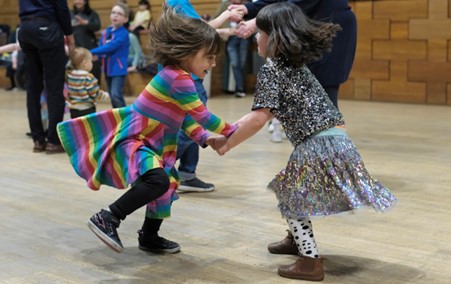
A pair of children, participating in a Family Barn Dance at Cecil Sharp House, January 2025. Photo: Brian Slater.
Street Cries
Street Cries are the historical version of the shouts and calls of market traders. They precede the idea of modern advertising by hundreds of years, but were catchy, memorable and distinctive, a bit like a modern jingle.
Many folk song collectors came across street cries when collecting traditional songs and noted them down. You can find songs advertising things such as logs, lavender, feather brooms, strawberries, and eels.
Some examples of street cries:
- Lavender Cry - Roud no. 854.
- Brighton Fish Cry - Roud no. 23439.

Cecil Sharp’s notation of Esther Williams’s Lavender Cry, which she sang to him on 23 July 1908. Image: VWML digital archive.
Wassails
Wassails are songs sung whilst Wassailing - an old English tradition usually celebrated around Twelfth Night (5th January) or Old Twelfth Night (17th January) to welcome in the New Year. The term wassail is thought to come from the Old English ‘waes hael’ (be thou in good health) and some people think it could have connections with pre-Christian Anglo-Saxon traditions.
Wassailing traditions usually consist of making a wassail (a hot mulled punch often made from cider or apple juice), and taking it from door to door whilst singing and drinking, in a similar way to carol singing traditions.
There are also orchard visiting wassails (especially in the south west of England), where people drink and sing to the health of the trees, sometimes banging pots and pans to scare away evil spirits, so that they might have a good harvest that year.
Wassail songs usually speak about visiting different people in the community and describe the drink, bowl and toasted bread, which is sometimes put in the trees.
There are many different regional variations on wassailing traditions and people still create new versions today, sometimes even wassailing community gardens or allotments.
Some wassail songs include:
- The Gower Wassail.
- Here We Come A-Wassailing.
- Apple Tree Wassail
All wassail songs come under Roud no. 209.
Work Songs
Work songs are sung by people whilst doing rhythmic labour. In England, there aren’t many documented examples of rhythmic work songs. In Dorset, folklorist and song collector Peter Kennedy recorded workers at a stone quarry in 1954, who sang together to help them to hammer in time whilst splitting large areas of rock apart. Apart from that, the main work songs sung in England that we know about are lace tells and sea shanties, which you can find out more about below.
Lace Tells
Lacemaking tells are work songs and rhymes that were sung by lacemakers, particularly whilst learning in lace schools. The songs helped them concentrate on their work, with the movement of the bobbins being timed by the beat of the song.
Historically, they were sung unaccompanied and often contain parts of ballads, nursery rhymes and even hymns. Many texts of lace tells have been collected, but very few melodies have survived, however it’s assumed that they may have been sung to the same tunes as the various songs they contain parts of.
Some examples of lace tells:
- Nineteen Miles As I Sat High - Roud no. 17769.
- A Lacemaker’s Song - Roud no. 1144.
Sea Shanties
Historically, shanties were works songs sung on board sailing ships which helped to coordinate a ship’s crew during repetitive jobs, such as raising and lowering the sail, hauling up the anchor and pumping out water from below deck. However, the term shanty is often now expanded as a musical category to include other sea songs.
Sea shanties usually have a call and response form, where verse lines (historically sung by a ‘shantyman’) are interspersed with refrains and choruses that would be sung by everyone else. The person singing the verse lines would sometimes improvise lyrics.
British sailing ships often had crew members from different places in the world working alongside each other and there are many different musical and linguistic influences on the development of shanties. These include:
- Traditional British and Irish songs and dances tunes.
- Songs sung by enslaved Africans in America or the Caribbean.
- Spirituals and hymns.
- Other European music/languages such as French, Breton, and Dutch.
- Music and language from other parts of the world, such as Polynesia
Shanties were not permitted in the Royal Navy but were often sung in the Merchant Navy and in the context of trans-Atlantic trade. This means that shanties have historical connections to the trafficking and enslavement of people from Africa, as many ships were trading goods from places that had enslaved workers, and shanties may have been sung on ships that were trafficking people.
The development of steam power and modern methods of shipping meant that the practical usage of shanties as work songs died out in the first half of the 20th century. However, sea shanties are still very popular today and have had various moments where they have entered mainstream consciousness. You can find many sea shanty bands, choirs, singing groups and festivals.
Some examples of sea shanties:
- Santianna - Roud no. 207.
- A Long Time Ago - Roud no. 318
- Let the Bulgine Run - Roud no. 810
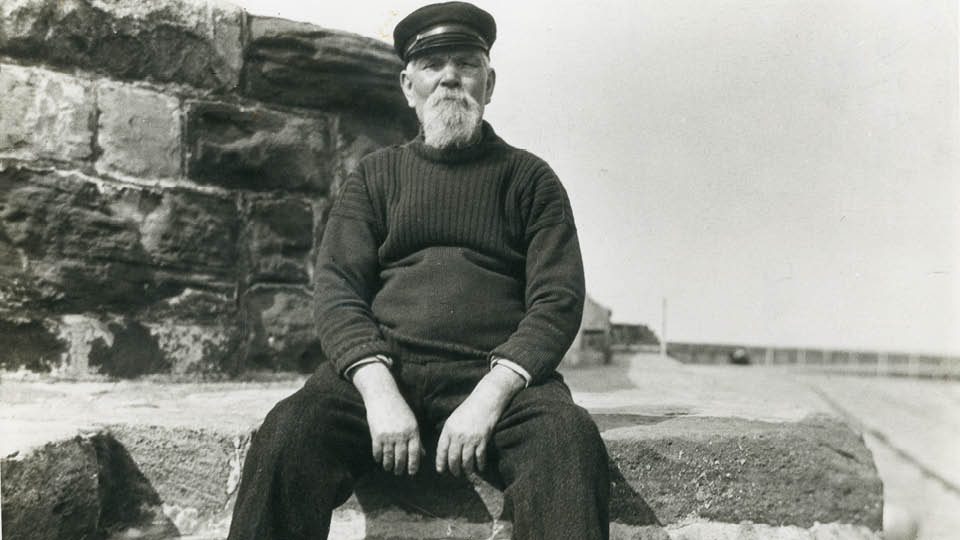
John Short (1839 - 1933) from Watchet, Somerset. A sailor and shantyman who later worked as a town crier, from whom Cecil Sharp collected songs. Photo: Cecil Sharp.