

Beginners’ Guide to English Folk Song

Granny’s Attic. Photo: Maria Alzamora, 2021.
Resource Credits
Written by Hazel Askew, 2025.
Original version by Gavin Davenport, produced by the English Folk Dance and Song Society (EFDSS), June 2014.
Copyright © English Folk Dance and Song Society, 2025
- If not specified and credited otherwise, pictures are copyright of EFDSS.
- Permission is granted to make copies of this material for non-commercial educational purposes.
- Permission must be sought from EFDSS for any other use of this material.
How to Use this Resource
This resource is an introduction to English folk song and is designed as the first stop for someone interested in the subject. It gives an overview of these songs today, as well as some of their history. It will also give an insight into where and how they are sung, how they are learnt, different types of song and some of the main themes they contain.
This resource assumes some basic musical knowledge, such as what ‘chord’ means, or the concept of ‘harmonisation’.
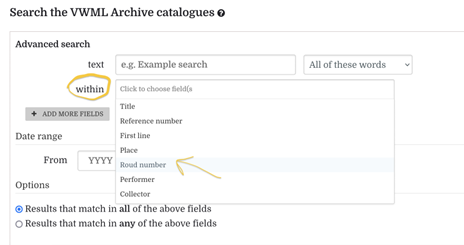
Song examples are listed with their Roud number (see the section below on the Roud Index). If you want to find these songs, they are easily searchable with their Roud number online, or you can search on the Vaughan Williams Memorial Library digital archives, using their Roud number or title in the search field.
1 - How to find the search field on the Vaughan Williams Memorial Library Website:

2 - How to search on the website using a Roud number:
A Note on Historical Context
Historical materials held by the VWML may contain content considered offensive by modern standards. Teachers are advised to check these links before sharing with students as materials may need contextualising.
Introduction
This resource is a guide to the wealth of songs that are currently understood as English folk songs. These songs are part of a global family of musics that are shared from person to person over generations, often referred to using terms such as ‘folk’, ‘traditional’, ‘roots’, ‘heritage’ or ‘old songs’.
What is a folk song?
There is no universal agreement about what is or isn’t a folk song. The term was first used in the 19th century to describe the music of ‘the people’, which meant songs people sung for their own and others’ entertainment at a time before recorded music, television or internet. Before then, these ‘folk’ songs would have just been referred to as ‘songs’.
People often use the term ‘folk song’ to refer to traditional songs - old songs that have been passed from person to person over time in what is known as an oral (or aural) tradition. Many of these songs began as authored, printed pieces, but were anonymous or the original creator has been forgotten. People also still write new folk songs today, some of which enter contemporary oral singing traditions.
Today, the word ‘folk’ is also used commercially to describe a genre of music, just as you have jazz, classical and pop etc. This genre has no fixed boundaries, but usually describes traditional music and music connected to or influenced by traditions. However, it is sometimes also to describe a broader range of musics that might also come under headings such as ‘acoustic’, or ‘singer-songwriter’.
This resource defines English folk songs as English language songs sung in England, that are part of, or have connections to, oral traditions - whilst acknowledging broader ranges of definition.
English folk song and its connections
Like folk songs from other parts of Britain and Ireland, English folk songs draw on a broad range of sources, such as:
- ancient ballads.
- popular songs.
- songs from plays and pleasure gardens.
- music hall songs.
- songs with unknown authorship or provenance.
- music composed by singers from oral traditions.
- music composed by contemporary folk performers.
Some folk songs deal with local and specifically English events or themes. However, many folk songs popular in England were also popular in other places too and were circulated aurally and by print. Sometimes a song that is famous for being from one place or country, could actually have originated in another, and sometimes we don’t have enough historical records to know the whole story.
This means there is sometimes no clear-cut separation between English language folk songs from England and from other places. This is true in today’s global society, as well as historically, when oral singing traditions were much stronger.
English folk songs are related to the songs of many other places, including:
- songs from other parts of Britain and Ireland - songs travelled between these countries as people did, and you can find many versions of the same song or story, but with differences in words and tune. This sometimes makes it difficult to know where a song originated from.
- songs from other places in Europe - you can often find similar stories and folklore in English and European folk songs, even when they are in different languages.
- songs from places such as North America and Australia, where large numbers of English people moved for varied and complex reasons including colonialism, the transportation of prisoners, and economic migration.
- sea songs and shanties from other parts of the world, as sailors from different countries often worked alongside each other as they travelled around, and shared songs and musical ideas.
Where they are sung
Anyone can sing an English folk song. They don’t need to be studied for years before you can sing them and join in with other singers. Historically, these songs were social songs and would have been sung in front of, or with, people you knew from your community, in the way that Christmas carols or football chants are sung now. However, this changed during the 20th century and you can now hear folk songs sung on stages too.
Today you can hear folk songs:
- at concerts and at venues performed by professional folk singers.
- at folk clubs, singarounds and open stages, as both performance and participatory music.
- being sung by choirs and other singing groups such a sea shanty singers.
- at folk festivals.
- at community events and celebrations.
- in homes.
- in videos and recordings online.
How they are learnt
English folk songs are part of what is known as an oral (or aural) tradition - music that is passed on from one generation to another through listening and playing, rather than learnt from written sources. However, songs have been collected and written down by people over the last 500 years, and many people nowadays learn them from written sources such as songbooks and archive manuscripts, as well as from recordings and online videos.

Singer and fiddle player Eliza Carthy at Wychwood Music Festival 2007. Photo: Damian Rafferty.
Collectors
At various times, English folk songs have been a focus for ‘collectors’ who transcribed and recorded songs in order to preserve them. Various people have notated English folk songs ‘source singers’ (singers who have learnt a song from the oral tradition) in the past and some people are still collecting today. The largest period of collecting was the early 20th century, a time when many oral traditions were dying out. This period of time has become known as the first folk revival.
Some well-known collectors from this time include:
- Lucy Broadwood.
- George Butterworth.
- George Gardiner.
- Anne Geddes Gilchrist.
- Percy Grainger.
- Maud Karpeles.
- Frank Kidson.
- Ella Mary Leather.
- Cecil Sharp.
- Ralph Vaughan Williams.
Some of these collectors (such as Ralph Vaughan Williams, George Butterworth and Percy Grainger) used the songs they collected to make arrangements of English folk songs that formed part of their classical music compositions.
Collecting folk (or traditional) songs can come with challenges and controversies over issues such as:
- what material is or isn’t considered to be a folk song - some collectors didn’t include music hall songs or what they considered popular songs, and some removed some words or verses they didn’t think were appropriate.
- who the songs were collected from - in the early 20th century, collectors were looking for English folk songs, but focused on certain groups of people, so the records only reflect the music of some of the population in England. For example, more songs were collected from men than women, and collectors rarely ventured outside of working class white communities.
- where the songs were collected - many early 20th century collectors focused on rural areas as this is what they associated with folk song, often ignoring towns and cities.
- what the singers chose, or felt comfortable singing - sometimes people would only share songs they felt were appropriate to sing to a collector from the middle classes.
- the complexities of middle class people collecting working class culture.
All these factors mean that English folk song collections are not a complete picture of folk song in England. They are influenced by the opinions of the collector and the values and customs of society at the time.
The fact that English folk songs were collected also means that these constantly evolving songs became recorded in fixed versions, which can often be seen as ‘original’ or ‘authentic’, when really they are just a snapshot of one moment in a song’s journey.
Nevertheless, the wealth of material gathered at this time is still a great musical and historical resource, much of which can be found in the Vaughan Williams Memorial Library online archives.
The Roud Index
The Roud Index is a numbering system for English language folk songs collected from the oral tradition anywhere in the world. Every different song is numbered, with different versions of it having separate entries, but with the same number. An entry in the Roud Index also includes the name of the original singer, date collected, collector, place collected where you can see or hear the song.
The system was invented in the 1970s by Steve Roud and is now hosted on the Vaughan Williams Memorial Library website, where you can use it to search all the known English language songs from oral traditions. You can also use Roud numbers to search other archives that contain English language folk songs.
You can usually find any folk song’s Roud number easily online. It can be very useful for looking up different versions of a song and telling you all the different places in the world it has been sung.
See the ‘How to Use this Resource’ section above for more information on how to search using a Roud number.
How they are sung
There isn’t one ‘correct’ way to sing an English folk song, and much of it is the personal choice of the singer.
Before the 20th century, singers largely sung unaccompanied without any instrumental backing, but today many people use instruments to ‘arrange’ a song or make vocal harmonies. There are also many folk, community and other types of choir that sing and perform arrangements of folk songs with multiple vocal parts.
There are common styles of harmonisation, counter melody, chords and ornamentation (musical decoration), but these are also ultimately the creative choice of the singer/accompanist.
There are also many different styles of vocal delivery when singing English folk songs. For example, some singers use a lot of ornamentation in their singing and others use very little or none.
Conventionally, English folk songs are sung in a way that feels natural and comfortable to the singer, allowing them to communicate the story and meaning of the song. You can sing in your own accent and say the words in a way that feels natural to how you speak them. Singers might change some language or dialect words if they feel unnatural for them to use and in order to avoid imitating an accent that isn’t their own.
Unlike in opera or musicals, singers don’t usually act out the words. Many traditional singers sing in a way which is fairly understated in order to keep the focus on the songs and the meaning, rather than themselves.
However, it has become traditional to be creative with English folk songs, so experimenting in musical arrangement and vocal delivery is also a part of the contemporary folk performance scene.

Cecil Sharp House Choir in rehearsal with choir leader Rose Martin, March 2020. Photo: Rosie Reed Gold.
An evolving tradition
The main traditional element of an English folk song is the melody line (a single line of tune). There is rarely one ‘true’ version of a song, as they have been shared from person to person over many years and have changed during this process, just as communities have changed over time. The knowledge of who first sung or wrote a song has often been lost and the music has lived on through being played and appreciated by people over the decades and centuries.
Many people who sing English folk songs decide to edit or even rewrite songs. It’s common for singers to collate a version of a song from multiple sources (perhaps using a song’s Roud number to look at different versions), and even write additional words or change the tune.
You can also find many contemporary English folk songs - new pieces of music where the composers are often known and may still be living. Contemporary folk songs may use the styles, forms and structures of traditional material for inspiration, as well as being influenced by other types of music. Sometimes these songs also become part of the oral tradition and evolve as they are sung by many people over time.
Some challenges in singing English folk songs
A singer of English folk songs has to decide what they feel comfortable singing about and what themes and stories they want to share with the people listening.
As with any historical resource, when looking at old or traditional folk songs, you may come across language, attitudes or stories which have sexist, racist, ableist or other offensive elements. As our values change over time, historical material can become outdated, and we have to make a choice about what is appropriate to sing today. This is an ongoing process that changes all the time and something a folk singer, or anyone working with historical material, has to take into consideration.
Some singers choose to deal with some of these issues by looking at different versions of a song (perhaps by using its Roud number) and picking the one they want to sing, constructing a song from multiple different versions, or perhaps even rewriting some or all of it. And of course, there are some songs a singer will decide are not appropriate to sing.
There are English folk songs about all different elements and experiences of life. This includes difficult topics such as: accounts of historical tragedies, injustices, death, murder, incest, the hunting of foxes, whales, hares and other animals. It is not necessarily inappropriate to sing a song about difficult things - like any form of art, it can show us a different perspective on life, help us to learn by hearing about a different experience, or teach us about a historical event. However, singers have to make a judgement on what they feel comfortable singing about and what an audience might feel comfortable hearing.
A singer also needs to consider whether a song is reporting on a difficult event, or whether it is offering an opinion or biased account of it, and whether they agree with the perspective offered in the song and think it needs to be heard.
How the song is performed can also help to communicate a singer’s interpretation of a song and their reasons for singing it. This may be through how it is introduced on stage, or how it is arranged musically.