


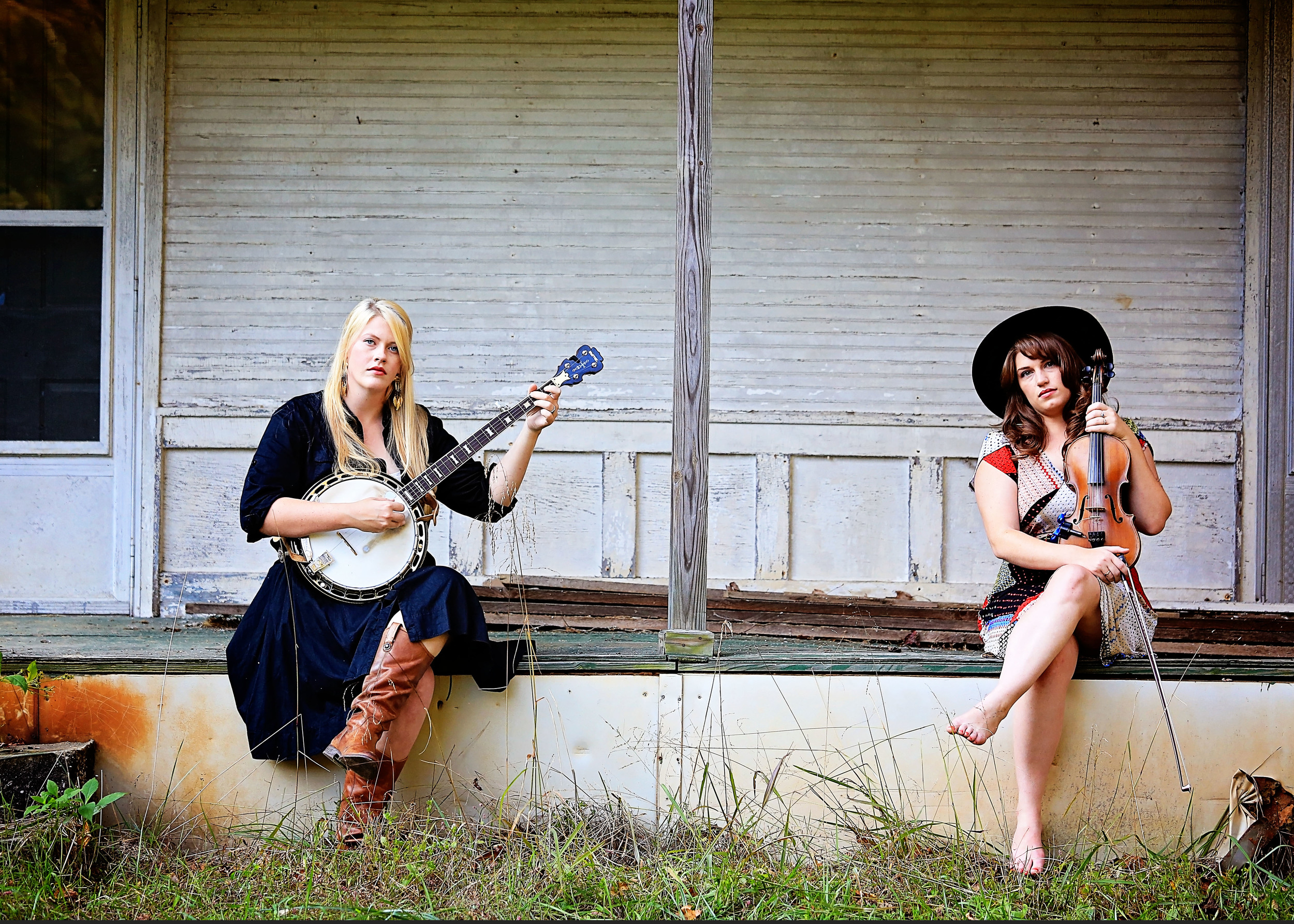
Ahead of their gig at Cecil Sharp House this month, the country-folk duo share their thoughts on 'Hillbilly' stereotypes, folk's relationship to political struggle and Cecil Sharp's work in their native Appalachia...
How did you both get into traditional music?
Linda Jean's mother played three-finger banjo in Woodford Co., KY and Montana's Papa was great square dancer in Knott Co., KY.
Despite growing up around regional traditions, we didn't gather an appreciation for traditional music until we immersed ourselves within it at Morehead State University where we attended college. This mountain town had a diverse music and art scene and MSU offed a program in which you could learn various styles of traditional music. We were drawn to delve into Kentucky specific musical history within the traditional music archives. We spent many nights holed up in the archives to listen and learn intensely.
You often self-describe your music as ‘hillbilly music’, I was curious what that term meant to you and why you choose to use it? A lot of people might view it as a negative phrase…
"Hillbilly" is a complex word. It is often used as an insult and with intent to harm; but to the people of Central Appalachia it is a familiar word we've grown up hearing. Some folks saw shame in the word but those of us who resist migration and "the brain drain" carry the label with endearment.
Also, it has been used historically to categorize the musical styles that have come from our region. Go to a used record store and you'll quickly find that everyone from Grandpa Jones to George Jones had been classified as Hillbilly Music at one time or another. At the same time, this word can be hurtful when used flippantly. Part of our mission is to own the word and to educate what true Hillbilly culture is about.
We announce at our shows how we became the first women with Bachelor of Arts degrees in traditional hillbilly music, yet still, after shows we'll have someone who thinks they're awful cute ask us if we can read and write. Now, tell me who's ignorant? There ain't nothing more dangerous than an educated hillbilly.
You recently won an award for your song ‘Cigarette Trees’ about strip-mining. Tell me about the relationship between folk music and politics for you both?
The folk singer has always carried the cross for the common people because we are common people. A folk singer can't help but relay the stories, struggles, and triumphs. A song is more easily digested than a Facebook argument. You listen to songs with your heart, not your politics. However, in such a political climate, how can one avoid writing about the issues at hand that affect our world and our people on a daily basis? Like strip mining, for example. There's a huge population in Kentucky that has no access to clean drinking water, due directly to coal mining practices in those areas. That's what "Cigarette Trees" is about. The decimation of our land directly affects the lives and well being of our people who choose to stay here despite less than ideal conditions, politically and socially. You often don't choose what you write about, it just comes out. I think we're all more in tune with politics these days due to media coverage and social media outlets and access. Some people tire of it and don't want to hear about it in their music. Artists and musicians often get persecuted for their political slants and feel the burn of people who don't identify with those beliefs. The two of us have different beliefs and values and politics that we hold dear. But we're still able to move forward and make music that we think someone can relate to and that's very satisfying work to do together.
You said in the past that your song writing reflects “subject matter that little girls ought not to talk about.” What are some of the unspoken rules in your opinion about which topics female musicians should or shouldn’t tackle?
Little girls aren't traditionally supposed to write about 'men's work', industry malpractice, their reproductive rights, their representation, and ugliness in general. "Stand still, sing pretty." I think some of the most powerful protest songs in history have been written by women. Women in the traditional sector like Jean Ritchie, Loretta Lynn, Hazel & Alice were absolute pioneers and we couldn't write these songs without the ground work they laid for us.
We don't feel inhibited by these "unspoken rules." However, it can be intimidating to share songs that you know are going to be divisive and controversial. These topics deserve a conversation and they deserve a woman's viewpoint and a woman's grace. We do our best to write songs that reflect our sense of womanhood and the place that shaped us into the women we are.
Following on from that, how do you find issues around gender tend to intersect with folk or traditional music? It’s often been a very male dominated field…
A lot of folks neglect to recognize that women have historically been tradition bearers, specifically of music and recipes. Many of the bluegrass legends, including the late Dr. Ralph Stanley have noted their mother as being their biggest musical influence. Ralph learned to play the old banjo styles and sing from his mother. Our dear friend and banjo historian, George Gibson, writes that at one time in the mountains of Central Appalachia the number of female banjo players heavily outnumbered their males counterparts. However, a career in music wasn't something that was accessible or encouraged for many women who had the talent and the drive, partly because of strict gender roles and expectations. So, I think that's a reason women in traditional haven't been seen as much. A woman who chose any career over a family was looked down upon and ostracized by their peers for a very long time. Those ideals and the long term effect of them can still be seen and felt.
But they were certainly there. Writing and singing and passing on the tradition. And we still are, just as loud as ever.
Your music is obviously deeply rooted in East Kentucky. How do you find it translates in different countries or parts of the US where audiences maybe aren’t so familiar with the scene?
For the most part, it translates pretty well. The themes and concepts are easily relatable. It's home music from rural places by rural people. I think that's why folk music is so universal. Rural or urban, rich or poor, there's a message in there for anyone. Appalachia has long been a depressed and oppressed region and the issues going on here can be translated across the world. We've found through our performing and sharing songs and stories in the U.S. and internationally, people are usually very grateful to hear about the issues we have going on at home and how we are still struggling but refuse to stop fighting. This summer there was a coal miner's strike in Cumberland, KY due to miner's not getting their wages. The BlackJewel Miner's stopped a train hauling over $1 Million worth of coal and held their position for nearly 3 months. We shared their story at every opportunity and we had so many people express to us how they had no idea that was happening, how grateful they were to learn about it and asking how they could help and where they could donate. Sharing the stories and the songs of our people is very important to us and if we have a platform to help people, we'll stand tall on that.
I’m curious how familiar you are with Cecil Sharp House and its history? There are obviously some historic links between Cecil Sharp and his work collecting songs in the Appalachians… Is that a tradition you’re aware of?
We're certainly familiar with Cecil Sharp and his legacy and his important work in Appalachia. The connection between the songs that have been preserved here in Appalachia and their roots in UK is a big reason why we were so drawn to this music. The history, the work, the stories, the conviction in which they are sung is all very compelling and keeps something that is very old always very new to us. We have some dear friends that worked as field recorders in the 1960s and 1970s and collected songs here in Appalachia and we continue to respect and admire their work and foresight to take action to preserve our history when no one else was going to do it.
Lastly, for any readers unfamiliar, if you could choose one song to represent The Local Honeys best what would it be and why?
If you're gonna start somewhere, might as well start with the very first song on the very first album. "Cigarette Trees" is a song we've been singing for years now and there isn't a show that we don't play it. It's got a classic bluegrass/old time sound, punchy lyrics and an important message. It's our closest thing to an anthem.
The Local Honeys play at Cecil Sharp House on Wednesday 13 November.
