


We asked “Do schools do enough to link young people to their local cultural heritage?” We wanted to find out about the benefits and barriers of linking young people to their local cultural heritage in education, and celebrate examples of when it has been done well.
The conversation began with questions around the meaning of local cultural heritage. We took UNESCO’s definition of intangible cultural heritage as a starting point and focused on the cultural heritage local to the school. We discussed how intangible cultural heritage isn’t static and that there are many ways of exploring it to develop music and creativity.
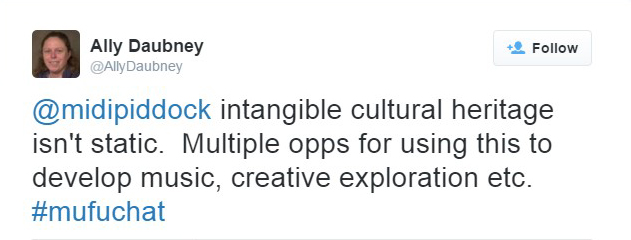
It was suggested that young people could learn about their local cultural traditions and then be encouraged to create new music in response. Others spoke about the value of looking at culture in history and that folk songs often give insight into ordinary experiences that the history books don’t cover.
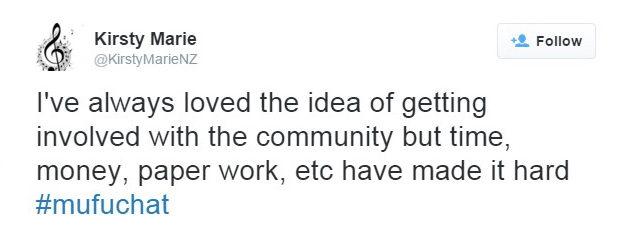
We asked about the barriers and challenges to this work. The response we received was that time is a factor: teachers revealed they are concerned about the lack of time to make links with their local community and do research into local culture.
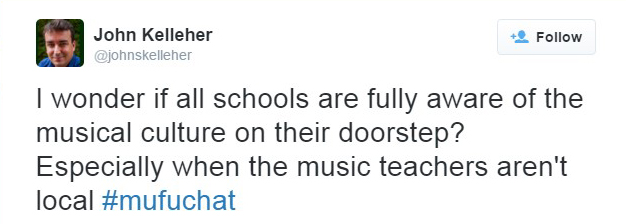
It seems that teachers might be unaware of, or not open to the musical culture on their doorstep, because of the restraints of the national curriculum. One teacher pointed out that schools often teach world and popular music but are unaware of English folk music.
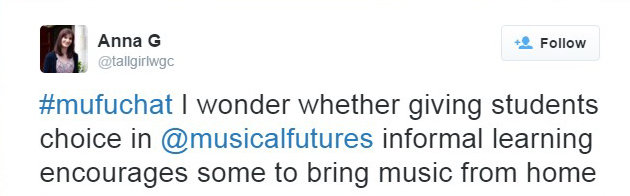
The discussion moved on to international versus local heritage. It was suggested that local heritage is informed by personal heritage which, through migration, is often international. It was pointed out that local cultural heritage may be irrelevant for schools that have children from a variety of cultural backgrounds, but one thing that could link the young people is their current geographical location. Anna Gower of Musical Futures wondered whether giving students choice through the Musical Futures informal learning method might encourage them to share music from home, which could bring together local and international influences in the music classroom.
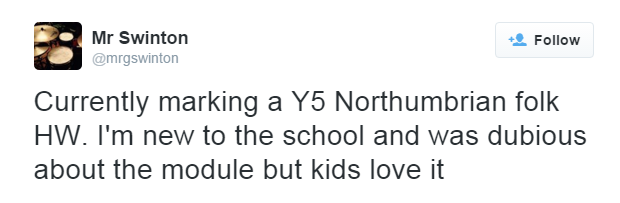
There were some nice examples of when teachers have introduced local cultural heritage into the classroom. We heard about schools in Lincolnshire creating music and art in response to the sailing of the Mayflower, and a Northumbrian folk project at Kings Priory School in Tynemouth. A teacher in Edinburgh is encouraged to teach Scottish music and enjoys playing in the school ceilidh band, and the Research Studies in Music Education Journal cited a school in Australia that links new migrant and refugee children with their heritage and host cultures.
At the end of the discussion, EFDSS did a poll to find out respondents’ opinions on whether schools do enough to link young people to their local cultural heritage and 87% thought not. During the Twitter discussion there were useful suggestions that could help schools to engage more with their local cultural heritage, such as making partnerships with organisations that explore local culture and identity; delving into local library or museum archives; and looking at online digital archives.
The EFDSS Education team is always happy to help support and share ideas around local cultural heritage with schools. We value linking young people to their local traditions as part of the rich and diverse cultural landscape of the UK. Our HQ, Cecil Sharp House, is home to the Vaughan Williams Memorial Library and an online digital archive of English music, songs, dances and customs can be accessed at www.vwml.org. Our online Resource Bank provides freely downloadable learning materials, audio and video for teaching folk arts in schools, community settings and beyond. If you’re interested in finding material from your own local area, items can be searched by location in the advanced search bar at www.efdss.org/resourcebank.
EFDSS is currently delivering The Full English Extra, funded by the Heritage Lottery Fund, in partnership with three national museums – the Museum of English Rural Life, at the University of Reading, Berkshire; the National Coal Mining Museum for England in Wakefield, Yorkshire; and the National Maritime Museum in Greenwich, London – combining folk arts and museum education to provide powerful new learning experiences for schools.
As part of The Full English project in 2013-14, EFDSS delivered a learning programme to 19 schools across England – both primary and secondary – demonstrating high quality practice with folk arts in education. At each school we delivered bespoke projects based around music, song, dance, drama, storytelling and other folk arts, mostly from the schools’ local area. The work was designed to link with curriculum objectives and included cross curricular links where possible.
For example, at Marton Primary School in Lincolnshire the students were introduced to traditional folk music, songs and dances to encourage exploration of the social history and heritage of Marton. Teachers used the material to support learning across the curriculum. Students created work in school as well as visiting their local museum and contributing to a village heritage trail. The project culminated in a community folk evening where pupils shared the work they had been creating across the term.
“Our children got so much out of learning about their locality – it brought our community closer together, which is not always easy, and it was an affirming experience for all of us.”
Naomi Maguire, Teacher at Marton Primary School
You can find out more about how we explored intangible cultural heritage as part of The Full English learning programme by watching our short documentary film, ‘Cultural Heritage Across the Curriculum’. Examples of the work delivered in schools are also available through our freely downloadable case study booklet.
Thanks to all who took part in our Twitter chat! You can see the Storify of the discussion here and add to the discussion on Music Mark’s Peer to Peer Network. Get involved in further music education conversations on Twitter by using the hashtag #MuFuChat on Wednesdays at 8.30pm.
