

Cataloguing
Cataloguing
The aim of the cataloguing was to transfer key information from the documents into an archive management database. The key information in a typical document included title, date, associated place and a summary of the content.
For collected songs and dances the key information also included the collector, the performer or informant and the first line.
To complete the cataloguing, the two qualified archivists for The Full English worked side by side in the archive office, a dedicated space where they brought boxes, one by one, from the archive store, laid out the documents and discussed their work.
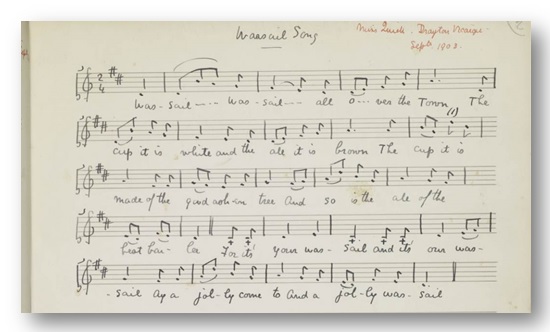
The original documents would be searched to find all the key information, especially the specific names, places and dates (as shown on the Cecil Sharp manuscript shown above). Each item was given its own description and image.
These descriptions enable anyone searching for information within The Full English digital archive to find results based on key words with corresponding photographs of the original document.
Each archive collection took a different amount of time to process because some were more complex than others. Overall, it took roughly one year for them to catalogue The Full English, with support from colleagues in the Vaughan Williams Memorial Library.
In order to fully understand the meaning of the letters and notes accompanying songs and dances, it was necessary to conduct research into the names, places and books referred to in the documents. Folk song collectors often wrote to each other and exchanged ideas and material, sometimes using short hand to refer to people and publications they both knew.
The archivists became adept at understanding these documents. Decision-making is an important part of the cataloguing process. For each document a judgement had to be made as to how much information to include in the description and how to convey that information. For example, if a place name had changed, was the historical or current name? Similarly, should archaic spellings be modernised and how would this decision affect search results? Some documents presented quite a challenge! Illegible handwriting offered an excellent opportunity to hone skills in palaeography. The handwriting of Frank Kidson and Ralph Vaughan Williams was particularly difficult to read.